A Changing Society and The Classic Romantic Comedy Come Together

By Sarah Penley

      A romantic comedy movie is defined as “ a movie or play that deals with love in a light, humorous way.” Throughout the history of film, romantic comedies have been an integral part of the film industry.  Romantic comedies have always been extremely popular. Even before they were the classic rom com films of today. Whether the rom com is being watched in the theatres, opera houses, cinemas or just in your own home, audiences have always enjoyed laughing along with character’s as they fall in love.
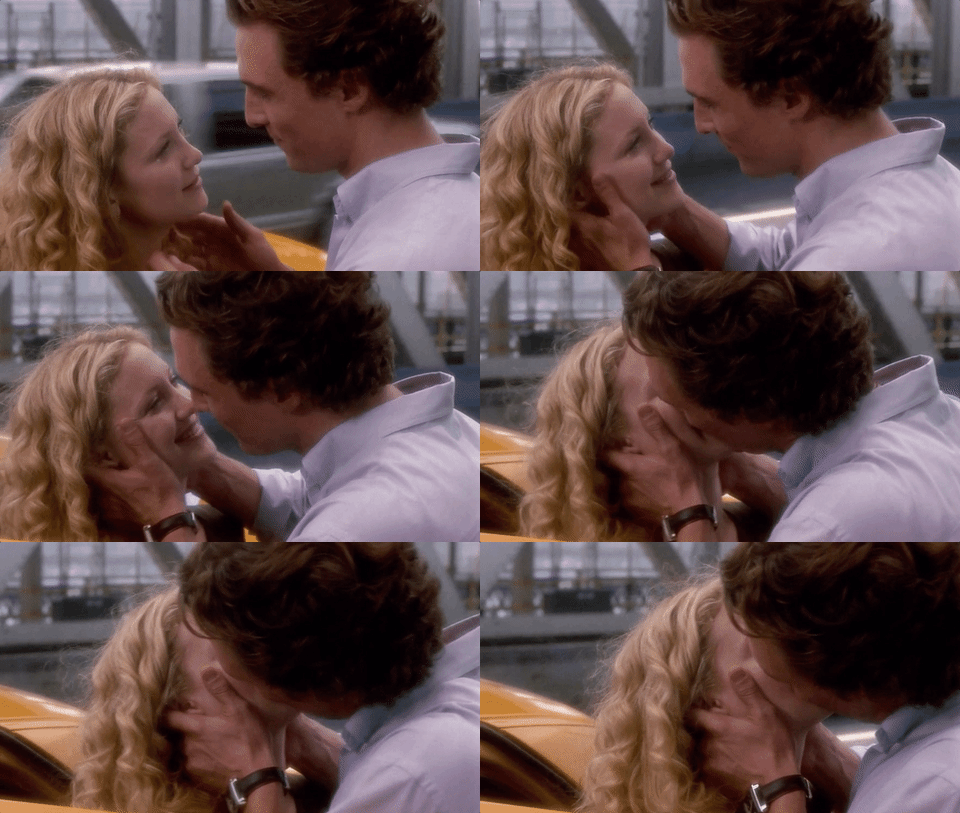
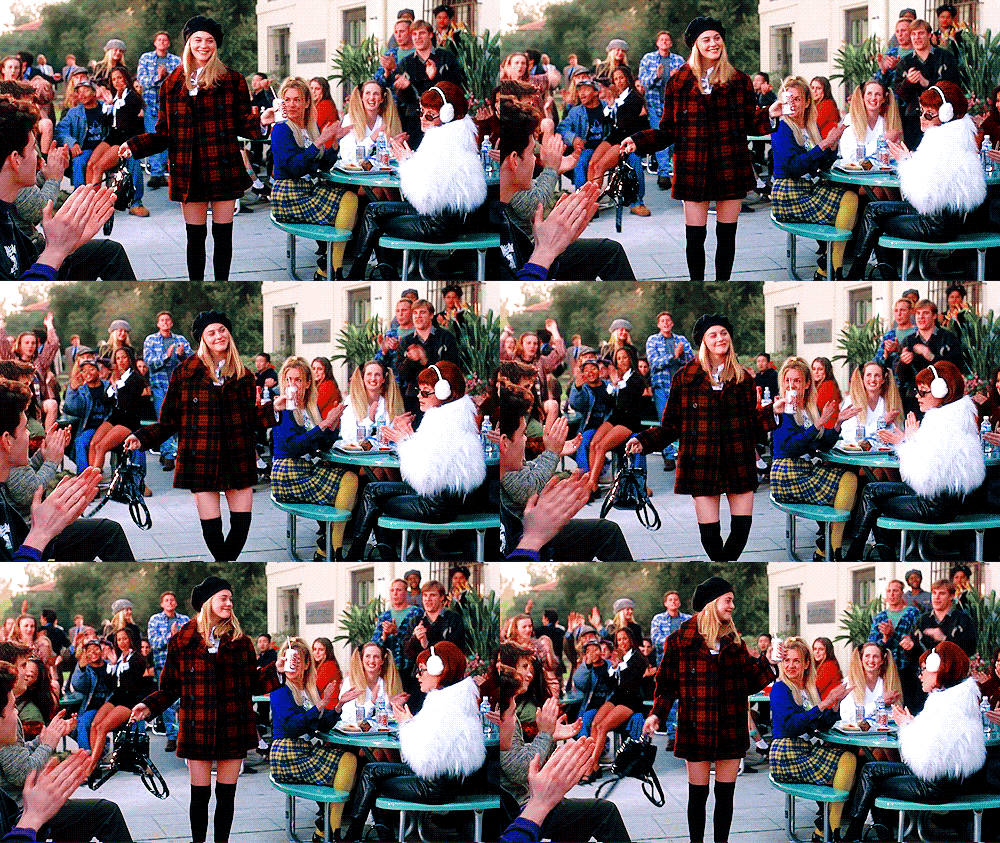
During the late 1990’s and early 2000’s romantic comedies were at its peak in popularity. Movies such as Clueless, 10 Things I Hate About You, and 13 Going on 30 were all extremely popular and are still being watched and remembered today. These are now our classic romantic comedy movies.
Romantic comedy movies have always followed a basic plot line of a man and a woman falling in love and being torn apart and eventually brought back together. These movies typically portray the stereotypes typical men and woman and portray the gender and relationship norm’s. However these stereotypes and norms in our society are beginning to change and as a result what audiences want to see being represented in these movies is changing as well.
Romantic comedies can be viewed as a reflection of the current society and time period in which we live. Whether the story takes place in the modern world or based in the past, these movies are a reflection of the current society’s norms and views on relationships.
         Modern day romantic comedy’s are beginning to show different types of relationships that have not been represented in romantic comedy movies at all in the past. These relationships include multiracial relationships and homosexual relationships. As a result the basic or typical plot line of rom com’s must change to adapt to these different relationships. The movie Love Simon that was released in 2018 show this scenario. The movie follows Simon who is a gay male that has not yet come out of the closet. While the movie does include typical romantic comedy tropes of him falling in love with an unexpected stranger, the movie is much different than the class rom com. Love Simon represents the lifestyle and problems faced in the lgbt community and shows situations that would not have come up in romantic comedy movies of the past.
        The role of women in these film has been changing as well to adapt to the changing role of women in modern society. The stereotypical girl has always been an essential part of Hollywood’s typical romantic comedy plotline. A boy and girl meet, they experience trials and eventually, the boy and girl fall in love and achieve a ‘happily ever after.’ These movies typically include the damsel in distress storyline. Todays romantic comedy’s are beginning to include female characters who are not defined by their romantic life. Movies such as Netflix’s Set It Up is a great example of this. The character of Kirstin is a successful business woman who puts her career first but is still able to find love in a light hearted comedy movie without appearing weak and helpless.

Romantic comedy movies are also beginning to represent more races than in the past. This is likely going to continue due to the success of the movie Crazy Rich Asians which featured an all asian cast. In October 2018 it became the highest grossing romantic comedy film of the last 10 years. The Washington Post, stated that the film  is a “escapist rom-com delight” and that “It will more than satisfy the sweet tooth of romantic comedy fans everywhere who have lately despaired that the frothy, frolicsome genre they adore has been subsumed by raunch and various shades of gray” Which is a statement that lets us know that romantic comedy movies aren’t going anywhere. These movies are readily able to adapt to the changing society norms and have already begun to do so successfully.

Avengers: Endgame Spoiler-Free Review

Avengers: Endgame Official Trailer

By Cameron Craig

Avengers: Endgame is shaping up to be the biggest movie of our generation. Not only has no other movie had twenty-two predecessors, but the pre-ticket sales for Avengers: Endgame eclipsed the record holding Star Wars: The Force Awakens in just six hours. Avengers: Endgame slammed its way to a $60 million Thursday night opening, the highest of any movie ever made.

The movie is such a generational event that the film’s director team, Anthony and Joe Russo, have released a statement urging fans to not spoil the movie for others that don’t have the luxury of seeing it opening day or opening weekend. The only other time this happened was during the opening weekend of Avengers: Endgame’s predecessor, Avengers: Infinity War.

Marvel’s CEO Kevin Feige had the film and production under such tight wraps that even some of the actors didn’t get the full script, especially Tom Holland, who is notorious for telling too much in interviews. Films are usually shot out of sequence for budgetary reasons, so there’s a good chance some of the actors will find out what the end result looks like at the same time as the rest of us.

The adequately titled film is the climactic culmination of the Marvel franchise and the arc of Thanos and his quest to “correct” the universe in the way he seems fit.  Avengers: Endgame deals with the direct aftermath of Avengers: Infinity War as the remaining members of the Avengers attempt to restore what was lost after Thanos wiped out half of all living creatures.

Bringing back brothers and directing duo Anthony and Joe Russo along with Avengers: Infinity War writers Christopher Markus and Stephen McFeely, Avengers: Endgame shapes up to be a cohesive and satisfying journey through twenty-two movies, dozens of character arcs and numerous iconic comic book moments. It’s apparent there’s a lot on the Russo’s plates over the film’s run time of 181 minutes as they juggle character arcs while simultaneously introducing the audience to the layman’s version of a complex plot. After the official merger between Fox and Disney, there was speculation that the X-Men could appear in Avengers: Endgame but thankfully was quickly shot down by Kevin Feige and the Russo brothers as it would only bloat the movie.

The film is a marvelous spectacle on both the cinematic and technical side of filmmaking. Waiting in line at IMAX for five hours to see the Arri Alexa 65 IMAX cameras on full display is truly something special. It’ll be interesting if the film will hold its own at the 2018 Oscars like Black Panther did, and potentially win a Oscar for special effects. The film also comes equipped with an elegant score from Marvel veteran Alan SIlvestri. On the cinematic side, the Russo brothers masterfully concluded the 11 year saga that brought many people’s childhoods to life. The impeccably cast Avengers deliver their best performances yet. No actor will ever don the suit as well as Robert Downey Jr., and no actor will ever don the shield as well as Chris Evans. The film is flushed with sentimental moments and callbacks to previous Marvel movies and will have longtime fans cheering, crying, and when the credits roll, being thankful for having been part of such a genre-defining journey that’s truly the end of an era.

But I suspect that some people will have issues with the film’s three hour run time. Especially since the film immediately is introduced with some pacing issues and sloppy editing that occupy a good portion of the first act. I’m all for films having a slow build like Blade Runner 2049 (2017), but there’s a difference between slow builds and pacing issues. The pace at which audience receives information in the first act is presented in a little bit of an incohesive way. While just about every character has their arc completed with a bow tie on it, there are some character that are completely sidelined due to the amount on the Russo’s plates.

But nevertheless, all of the film’s qualms or flaws are easily forgiven and easy to miss as you’ll likely be too entranced in the absolute joy that is the climax of Avengers: Endgame. I can’t commend the Russo’s and Kevin Feige enough for pulling off what is the most ambitious film franchise of all time. Their incredible ability to successfully juggle all of the characters, grandiose cinematic storytelling and bringing it all to a beautiful climax cannot be understated.

How REAL Is Reality TV?

By Amber Penley

People love reality television. From American Idol to the Bachelor, to Survivor, audiences become obsessed with these reality series because, unlike in typical tv dramas, these are real people on screen; real life. This is what spikes people’s fascination with these reality series. Audiences feel that these are not merely characters in a show, but real people, just like themselves. But just how real is reality television? Though these series portray real people, reality tv shows are far less “real” than one may think. From contrived scenes, creative editing, and even scripted lines, reality television is not true reality.

In an article from learnreligions.com “Ethics and Reality TV: Should we Really Watch?”, author Austin Cline discusses that one of the attractions of reality TV is the reality of it. But as Cline explains, “One of the ethical problems of reality television is the fact that it isn’t nearly as “real” as it pretends to be.” As Cline points out, reality tv is misleading to audiences. People watch these shows and believe they are witnessing real-life situations, but these situations are put together and contrived by editors to come off a certain way.

The most alarming point that Cline makes in this article is the fact that reality series are even capable of portraying racial stereotypes by making contestants act a certain way. Producers make contestants conform to a recognizable stereotype for the audience, such as the “angry black woman”. This is disturbing because these stereotypes are being portrayed in a show that is supposed to be real. Audiences will fall for the portrayal of these stereotypes because they will believe they are watching real life. Cline explains “after so many reality programs, we can discern a pattern of characters that isn’t very far different from the stock characters found in fictional programming.” Reality series create characters, that are not real, and promote the idea of racial stereotypes.

Audiences witness many of these stereotypes on every reality series, but some far more than others. One reality show that immensely portrays these stereotypes is the dating series Temptation Island, “where couples put their love to a test and determine whether they should be together or not. Couples live together in the same house as hot singles.”. From merely watching this trailer, multiple stereotypes can be named off, from the dumb blonde, to the sassy black girl. This series, just like every other dating series, uses stereotypes to lure audiences in.

The famous stereotype of the dumb blonde also frequently appears in the Bachelor. The signature dumb blonde, Hannah B., from the previous season of the Bachelor was actually such a popular contestant she has been selected as this year’s Bachelorette. Perhaps her identity as the dumb blonde is what made her such a well recognized contestant.

Not only are reality series guilty of the portrayal of stock characters, but of creating a story, rather than true reality. In an article posted by E News, “Real or Fake? The Truth About Some of Your Favorite Reality TV Shows”, author Lauren Piester provides evidence that not everything we see on reality television is real. Her basis of this claim is that “reality TV is a very manipulated format where the basis of it is that real people are put into unreal situations to create a story.”. Some shows are much more guilty of creating made-up storylines, whereas other series use creative editing and scripted lines to portray a particular storyline.

House Hunters, a reality series where couples look at multiple houses then decide which one to buy, is an example of a reality series creating a fake story. Piester explains that the people who are selected to be on this show have already picked out a home, and do not need any help in deciding which home to buy. After former participants of the show admitted to this, HGTV released a statement stating that  “To maximize production time, we seek out families who are pretty far along in the process. Often everything moves much more quickly than we can anticipate.”. There is no genuine “house hunting” going on here, merely a story manipulated to gain viewers interest. Audiences of the show anxiously watch and wonder which house the homeowners will select, little do they know they have already chosen a house.

House Hunters is just one of many reality series that are not real. These series are put together to create a story, just as on any ordinary television drama. The real issue here is the fact that these shows are trying to portray themselves as “real”. This is very manipulative to viewers. But this is a key aspect of reality tv that audiences miss, manipulation. Producers of reality series want to make money. To make money, they need viewers. Sure, real life is interesting and all, but we are well aware of the fact that our own real lives would be boring to witness on screen. Real life is not always interesting. This is why reality series producers try to create something much more interesting. Producers develop engaging stories that are not true, or intensely edit real filmed scenes to portray something entirely different than the reality of the situation.

In an article from business insider by Michelle Crouch, “13 Secrets Reality TV Producers Will Not Tell You”, Crouch discusses the true masters that tv producers are with editing in order to manipulate certain scenes that have been filmed. She states that producers often “take different clips and edit them together to sound like one conversation, sometimes drastically changing the meaning.” They even go as far as creating sentences from scratch. They call this “frankenbiting”. Crouch warns viewers of how to catch this manipulation technique, and that if a person on the show is speaking while the camera cuts away from them, this is most likely frankenbiting. TV producers will form together sentences to create statements that were never said. This is manipulative towards both viewers, and those who participate in the show. Many reality show participants have to face character defamation as a result of creative editing.

Reality shows are fun to watch. As viewers, we become so engaged with the drama of reality tv. We are fascinated by the idea that these series are portraying real life events. What we as viewers need to realize is that reality shows are not real. Though some series may be more real than others, we should not fall for everything we see on these shows. Continue to enjoy your Sunday nights of House Hunters and your Monday nights of the Bachelor, but do not fall for what you see. Be aware. These stereotypes, dramatic editing, and manipulated storylines we see portrayed on reality television are just as fake as in any tv drama.

ABC releases first trailer to new season of the Bachelorette

by Amber Penley

ABC has released an epic trailer to the new season of the Bachelorette airing May 13th, As seen in the above trailer, this season of the Bachelorette will feature Hannah B., former pageant queen, in her epic search for love. The trailer above shows Hannah dramatically walking as her pageant gown transforms into a sexy romper. The trailer concludes with the statement, “You think you know her? Think again.”. Based on this trailer, this should certainly be an exciting season of the Bachelorette.

New Reality Series, Songland, Seeks Writers, Not Singers

by Amber Penley


NBC’s new series, Songland, is set to air May 28th. As the trailer above shows, this series will be all about creating the next new song. As Joe Jonas states in the promo above, “This show is giving songwriters a real opportunity to pitch their songs”. This series is going to show people how music is made and the significance behind song lyrics, and all that goes into developing these lyrics.